
Mastering Modern house 2-Point Perspective: A Comprehensive Guide
Two-point perspective is a powerful tool for artists and designers, allowing for the creation of realistic and immersive representations of three-dimensional spaces on a two-dimensional surface. When applied to modern house design, it enables the depiction of sleek lines, dynamic angles, and a sense of depth that truly brings architectural concepts to life. This comprehensive guide will delve into the intricacies of two-point perspective, exploring its fundamental principles and demonstrating its application in drawing modern houses.
Before embarking on the journey of drawing a modern house in two-point perspective, it’s crucial to grasp the foundational concepts:
1. Horizon Line: The Eye Level
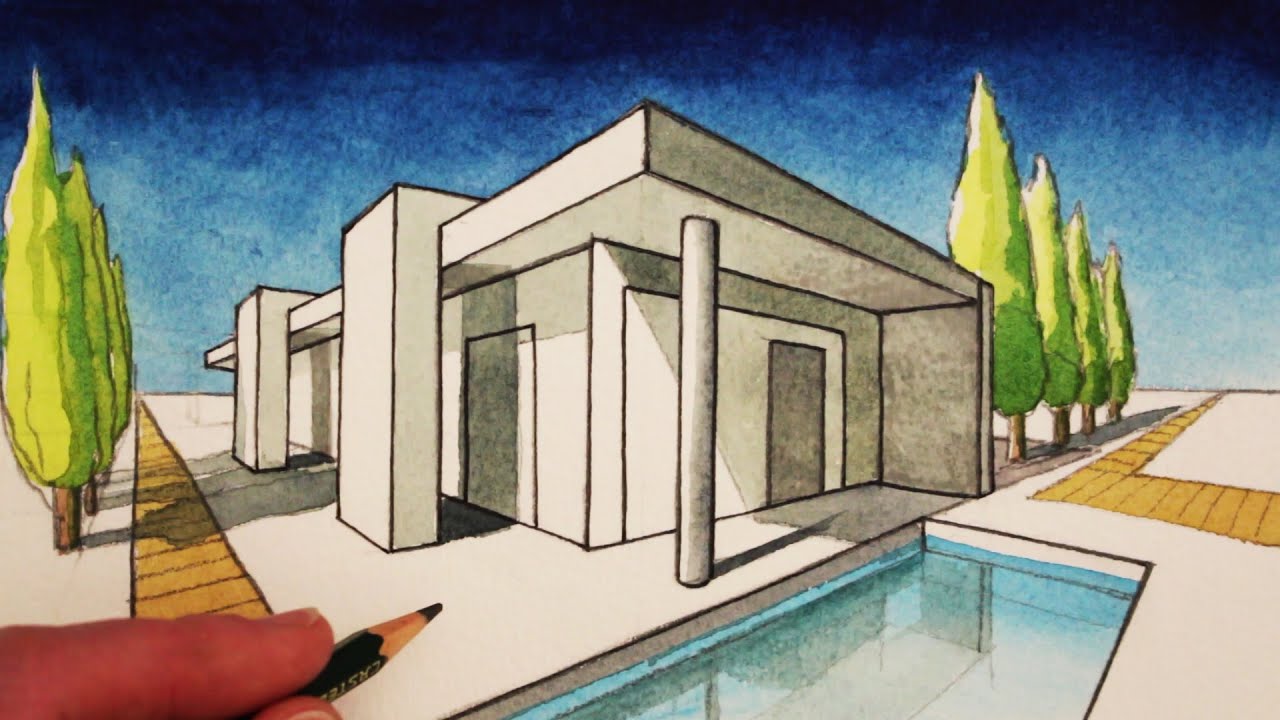
The horizon line is the horizontal line representing the viewer’s eye level. It’s the foundation upon which the entire perspective drawing is built. The placement of the horizon line dictates the viewer’s vantage point. A high horizon line creates a “worm’s-eye view,” while a low horizon line produces a “bird’s-eye view.”
2. Vanishing Points: Where Parallel Lines Converge
In two-point perspective, two vanishing points are positioned on the horizon line, far to the left and right. These points represent the point at which parallel lines appear to converge as they recede into the distance. All lines parallel to the width of the house converge at one vanishing point, and all lines parallel to the depth converge at the other.
3. Vertical Lines: Maintaining Parallelism
Vertical lines in a two-point perspective drawing remain parallel to the edges of the paper, representing the true verticality of the structure. These lines do not converge towards the vanishing points. This constant vertical attribute, combined with the two vanishing points give the perspective its signature look.
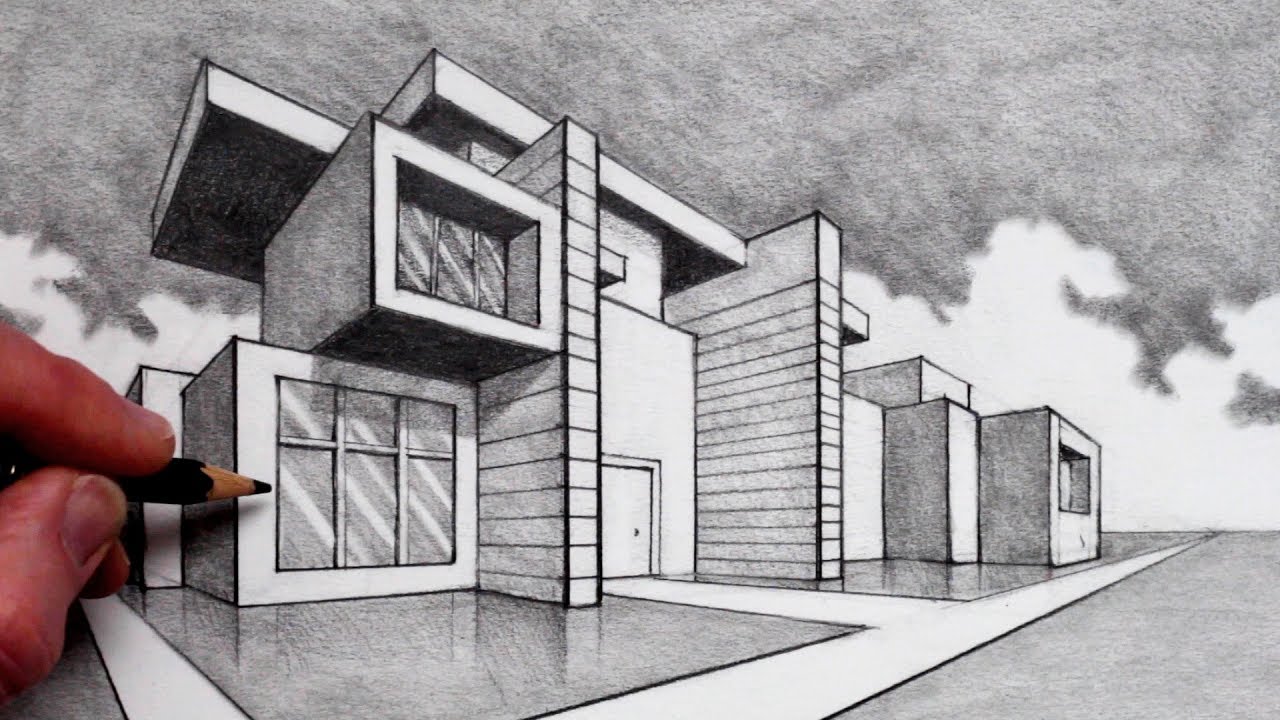
Now, let’s explore how these principles translate into the practical application of drawing a modern house in two-point perspective.
1. Establishing the Horizon Line and Vanishing Points
Begin by drawing a straight, horizontal line across your paper to represent the horizon line. Position the vanishing points at a significant distance from the center of the horizon line, ensuring they remain within the boundaries of your paper. The distance between the vanishing points affects the angle of the house. A wider distance results in a less dramatic angle, while a closer distance enhances the angular perspective.
2. Defining the Vertical Edge
Choose a point on your paper to represent the closest vertical edge of the house. Draw a straight, vertical line at this point. This line serves as the foundation for the house’s dimensions.
3. Extending Lines to the Vanishing Points
From the top and bottom of the vertical edge, draw lines extending to each of the vanishing points. These lines establish the receding edges of the house’s walls. These are often named perspective lines.
4. Defining the Width and Depth
Select points along the perspective lines extending from the vertical edge to define the width and depth of the house. From these points, draw vertical lines, representing the back edges of the house’s walls. Then, extend lines from these new vertical lines to the opposite vanishing points, completing the box-like structure of the main body of the house.
5. Adding Architectural Details
With the basic structure in place, you can begin adding architectural details that characterize a modern house. This is where the creative process expands.
5.1 Roof Design: Flat or Angled
Modern houses often feature flat or low-sloping roofs. In two-point perspective, flat roofs are represented by lines parallel to the horizon line, while angled roofs are created by drawing lines converging toward a vanishing point above or below the horizon. The angle and placement of the roof lines can dramatically impact the aesthetic of the house.
5.2 Windows and Doors: Framed Perspectives
Windows and doors can be incorporated into the design by drawing lines that converge toward the appropriate vanishing points. Pay close attention to the placement and size of these elements, ensuring they align with the overall perspective. Rectangular windows will show their perspective lines converging to the same vanishing point as the walls they are placed upon.
5.3 Overhangs and Balconies: Extending Planes
Overhangs and balconies add visual interest and depth to modern house designs. These elements can be created by extending planes from the existing walls, ensuring that the lines converge toward the correct vanishing points. Take special care when representing these to have a realistic look.
5.4 Material Representation: Line Variation and Shading
The use of line variation and shading techniques can further enhance the realism of the drawing. Thicker lines can be used to represent edges closer to the viewer, while thinner lines can suggest receding edges. Shading can be employed to depict the effects of light and shadow
Modern house design emphasizes clean lines, minimalist aesthetics, and the integration of natural light.
1. Open Floor Plans and Large Windows
Modern houses often feature open floor plans and large windows that maximize natural light. In two-point perspective, these elements can be represented by large, rectangular openings and extensive glass surfaces.
2. Cantilevered Structures and Geometric Forms
Cantilevered structures and geometric forms are hallmarks of modern architecture. These elements can be effectively depicted in two-point perspective, showcasing the dynamic interplay of planes and angles.
3. Material Palette: Concrete, Glass, and Steel
Modern house designs often incorporate materials such as concrete, glass, and steel. The textures and reflectivity of these materials can be represented through line variation and shading techniques.
4. Landscape Integration: Blurring Indoor-Outdoor Boundaries
Modern houses frequently blur the boundaries between indoor and outdoor spaces through the integration of courtyards, patios, and expansive windows. Two point perspective can effectively portray these features.
Practice Regularly: Mastering two-point perspective requires consistent practice.
Two-point perspective is an invaluable skill for artists and designers seeking to create realistic and compelling representations of modern houses. By understanding and applying the fundamental principles, you can effectively capture the essence of modern architecture, showcasing its sleek lines, dynamic angles, and captivating sense of depth. This comprehensive guide has provided a strong foundation for your journey into mastering the art of modern house two point perspective.


