
The Geometry of Modern Living: Deconstructing a 2-Point Perspective house
Modern architecture, with its clean lines, expansive glazing, and emphasis on spatial fluidity, lends itself remarkably well to the dramatic portrayal possible through two-point perspective. This technique, a cornerstone of architectural drawing, allows us to capture the three-dimensional essence of a building, showcasing its form and volume with striking realism. In this exploration, we delve into the creation of a modern house, meticulously constructed within the confines of two-point perspective, unraveling the principles that govern its visual impact.
Before embarking on the architectural journey, a firm grasp of two-point perspective is crucial. This technique relies on two vanishing points positioned on a horizontal line, known as the horizon line. These points represent the convergence of parallel lines receding into the distance. All lines parallel to the width of the house converge at one vanishing point, while those parallel to the depth converge at the other. Vertical lines remain vertical, maintaining their parallel relationship to the viewer.
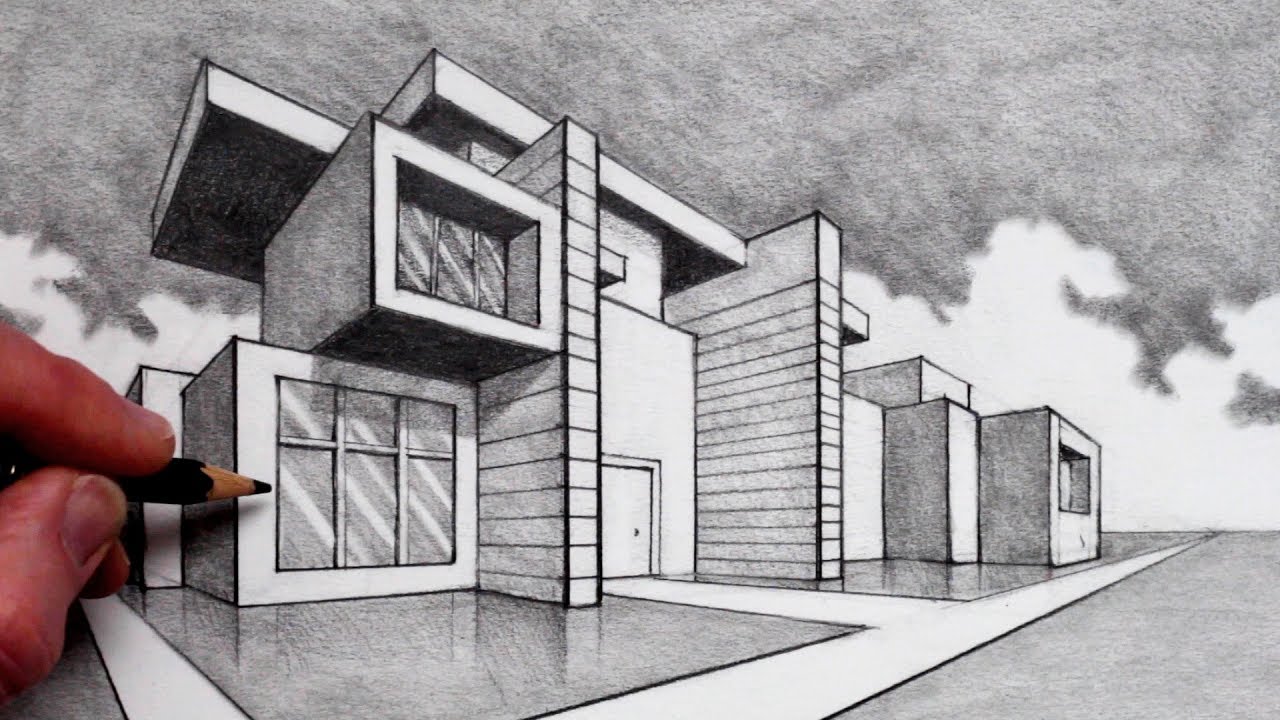
The horizon line, representing the viewer’s eye level, dictates the vantage point. Placing it high creates a “worm’s-eye” view, emphasizing the building’s height and grandeur. A low horizon line produces a “bird’s-eye” view, revealing the roof and overall layout. For a balanced, eye-level perspective, the horizon line is typically positioned at a comfortable height. The vanishing points, placed at a considerable distance from the drawing, ensure a natural and undistorted representation.
The initial step involves establishing the primary forms of the house. In a modern design, these often consist of simple geometric shapes: rectangular prisms for the main structure, cantilevered boxes for overhangs, and planar surfaces for walls and roofs.
Establishing the Corner: The Initial Vertical Line

The process begins with drawing a vertical line, representing the corner of the house closest to the viewer. This line acts as the central axis from which all other lines radiate.
Receding Lines: Connecting to the Vanishing Points
From the top and bottom of the vertical line, lines are drawn towards both vanishing points. These lines define the edges of the walls receding into the distance, establishing the building’s width and depth.
Defining the Depth and Width: Establishing Dimensions
At a chosen point along each set of receding lines, vertical lines are drawn. These lines determine the depth and width of the main structure. By connecting the endpoints of these vertical lines to the opposite vanishing points, the remaining edges of the building are defined.

With the basic form established, architectural details are introduced to enhance the house’s character and functionality.
Windows and Doors: Glazing and Openings
Modern houses often feature expansive windows and sliding glass doors, maximizing natural light and blurring the boundaries between interior and exterior spaces.
Window Placement: Aligning with Perspective
Window placement is crucial in maintaining perspective. The top and bottom edges of the windows are defined by lines converging at the vanishing points, ensuring they recede correctly. Vertical edges remain vertical.
Doorways: Defining Entrances
Doors are treated similarly, with their edges aligned with the vanishing points. Sliding glass doors, common in modern designs, are represented as large rectangular panels that recede into the distance.
Roof Design: Flat and Cantilevered Forms
Modern roofs are often flat or feature cantilevered sections, creating visual interest and providing shade.
Flat Roofs: Simple and Clean Lines
Flat roofs are represented by horizontal lines parallel to the horizon line. Their edges align with the vanishing points, maintaining the building’s perspective.
Cantilevered Roofs: Projecting Elements
Cantilevered roofs, projecting beyond the main structure, are constructed by extending the receding lines of the walls. The underside of the cantilever is represented by lines converging at the vanishing points.
Exterior Walls: Materials and Textures
Modern houses often incorporate a variety of materials and textures, such as concrete, wood, and metal.
Concrete Walls: Smooth and Solid Surfaces
Concrete walls are represented by smooth, planar surfaces. Shading and rendering techniques can be used to depict the texture and depth of the concrete.
Wood Cladding: Natural and Warm Elements
Wood cladding adds warmth and texture to the exterior. Lines representing the wood grain are drawn parallel to the receding lines, creating a sense of depth and realism.
Metal Accents: Sleek and Modern Details
Metal accents, such as steel beams and railings, add a sleek and modern touch. These elements are represented by thin lines and sharp angles, reflecting their metallic nature.
The house is not an isolated entity; it exists within a context. Landscaping and environmental elements are incorporated to create a complete and harmonious composition.
Ground Plane: Establishing the Foundation
The ground plane is represented by a horizontal line, parallel to the horizon line. Lines representing the edges of the driveway, pathways, and garden beds converge at the vanishing points.
Vegetation: Adding Life and Texture
Trees, shrubs, and other vegetation are added to soften the building’s sharp lines and create a sense of natural integration. These elements are rendered with varying degrees of detail, depending on their distance from the viewer.
Environmental Shadows: Enhancing Depth
Shadows cast by the house and surrounding elements add depth and realism to the composition. The direction and intensity of the shadows are determined by the light source, which is typically assumed to be the sun.
Rendering and shading are essential for transforming a line drawing into a realistic representation.
Light and Shadow: Defining Form and Volume
Light and shadow are used to define the form and volume of the house. Surfaces facing the light source are rendered lighter, while those in shadow are rendered darker.
Material Rendering: Depicting Textures
Different materials are rendered with varying techniques to depict their textures. Concrete is rendered with subtle shading, while wood is rendered with lines representing the grain.
Atmospheric Perspective: Creating Depth
Atmospheric perspective, also known as aerial perspective, is used to create a sense of depth and distance. Distant elements are rendered lighter and less detailed, while closer elements are rendered darker and more detailed.
Two-point perspective is more than just a technical drawing technique; it is a visual language that allows architects and artists to communicate their ideas with clarity and precision. By mastering the principles of two-point perspective, one can create compelling and realistic representations of modern houses, capturing their form, volume, and spatial qualities.
The modern house, with its emphasis on clean lines and geometric forms, serves as an ideal subject for exploring the power of two-point perspective. Through meticulous construction and careful attention to detail, a compelling visual narrative emerges, revealing the beauty and functionality of modern architecture. The process is a testament to the enduring relevance of traditional drawing techniques in the age of digital design, demonstrating the power of hand-drawn representation in conveying architectural vision.


